Engine Cover Solutions Supplier: A B2B Procurement Guide to Materials, MOQ & Factory Audit
An equipment distributor in the Gulf Coast region placed a container order for 800 heavy-equipment engine covers in August 2024. The spec called for "heat-resistant fabric." No temperature rating. No test standard. No chemical resistance requirement.
The covers arrived in October. By January 2025, the distributor had processed 127 warranty claims. Hydraulic fluid leaks had degraded the fabric coating on units installed near excavator engine bays.
The fabric beneath exhaust manifolds had stiffened and cracked after roughly 900 hours of exposure. The supplier pointed to the PO, which said "heat-resistant" without defining what that meant.
The distributor lost a fleet-services contract worth $47,000 in annual recurring revenue. The problem was not the supplier. The problem was the spec.
Engine cover procurement fails more often on the spec sheet than on the production floor.
A cover exposed to 180°C manifold heat and intermittent diesel-oil splash needs different materials than one shielding a stationary generator in a climate-controlled shed.
This guide covers what to specify, how to verify it, and what to look for when you walk the factory floor.
Material Specifications: Oil Resistance, Heat Tolerance & What Numbers to Put on the PO
The single most expensive mistake in engine cover procurement is ordering by material name instead of by performance spec. "Silicone-coated fiberglass" describes a category, not a product.
Within that category, coating weight ranges from 8 to 32 oz/yd², continuous-use temperature varies from 200°C to 260°C, and oil resistance depends on whether the silicone compound includes fluorinated additives.
Below are the four material categories that cover most industrial engine cover applications. Each row includes the minimum spec points to include on your RFQ:
| Material | Continuous Temp. | Oil Resistance | Typical Weight | Cost Index | Best Application |
|---|---|---|---|---|---|
| 600D Oxford + Double PU | -20°C to 80°C | Moderate | 280-320 g/m² | 1.0x (baseline) | Indoor generator covers, light-duty engine dust covers |
| Silicone-Coated Fiberglass | -65°C to 260°C | Good | 17-26 oz/yd² | 2.5x | Heavy equipment engine bays, exhaust manifold covers |
| PTFE-Coated Fiberglass | -73°C to 260°C | Excellent | 14-22 oz/yd² | 3.2x | Hydraulic equipment, chemical-plant engines, frequent oil splash |
| PVC Tarpaulin (Vinyl) | -30°C to 70°C | Moderate | 550-900 g/m² | 1.8x | Marine engine covers, outdoor stationary engines |
Three material decisions separate covers that survive 3,000 engine hours from covers that fail at 900:
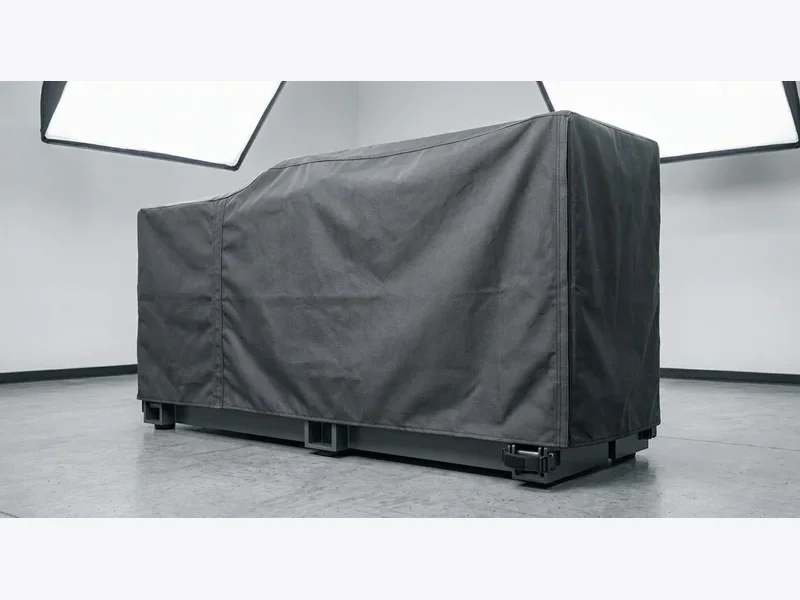
Coating quality and thickness. A silicone coating applied at 8 oz/yd² will delaminate from the fiberglass substrate after roughly 1,200 thermal cycles. A coating at 17 oz/yd² with a proper adhesion primer survives 5,000+ cycles.
The difference is invisible in a product photo. Specify coating weight to ASTM D-3776 and ask for the coating-adhesion test report, which a competent factory generates per production batch.
Thread specification. PTFE-coated fiberglass thread or stainless-steel-core thread for seams near heat sources. Standard polyester thread loses 40% of its tensile strength after 500 hours at 150°C.
A seam failure on an engine cover exposes the equipment underneath, and the failure almost always starts at the thread, not the fabric. The thread upgrade adds roughly $0.25-0.45 per cover.
Seam construction at stress points. A single-needle lockstitch on the corners of an engine cover carries the entire tension load when the cover is pulled tight over an exhaust stack or intake manifold.
A double-needle chain stitch with a 12 mm seam allowance distributes that load across two stitch lines and resists tear propagation. The labor difference is about 45 seconds per cover. The field-failure-rate difference is 3-5x.
MOQ, Pricing Tiers & Lead Times
MOQ in engine cover manufacturing is set by two constraints: the fabric supplier's minimum roll order (most technical fabrics sell in 50-100 yard rolls) and the pattern-making and setup cost at the sewing line.
The table below reflects standard OEM terms from industrial cover manufacturers:
| Order Type | MOQ (per design) | Unit Price Range | Lead Time |
|---|---|---|---|
| Trial / Sample Order | 25-50 units | 15-25% premium | 3-4 weeks |
| Standard OEM (600D Oxford) | 50-100 units | $8-15/unit | 5-7 weeks |
| Standard OEM (Silicone Fiberglass) | 100-200 units | $22-45/unit | 6-8 weeks |
| Custom Branding (any material) | 200-500 units | +$1.50-3.00/unit | +1-2 weeks |
| Bulk Volume (1,000+ units) | 1,000 units | 8-12% discount | 8-10 weeks |
Pricing on silicone-coated fiberglass covers varies most with coating weight. A 17 oz/yd² cover costs roughly 40% less than a 26 oz/yd² cover of the same dimensions.
If your application runs at 180°C rather than 250°C, the lighter coating grade suffices and the cost savings compound across volume.
Payment terms follow textile-industry norms: 30% deposit with order confirmation, 70% against copy of Bill of Lading. For first-time buyers, some manufacturers offer 50/50 terms after a successful sample round.
Letters of Credit add roughly $200-400 in bank fees, which makes them cost-effective above order values of roughly $15,000.
Lead times assume fabric availability in stock colors (black, gray, silver). Custom-dyed silicone or PTFE coatings add 10-14 days for formulation and color matching. Pattern development for a new engine model takes 5-7 working days from receiving accurate dimensional drawings.
B2B Factory Audit: 7-Point Checklist Before You Sign
A factory audit for engine cover manufacturing is not a box-ticking exercise. It answers one question: can this facility produce 500 units identical to the pre-production sample you approved?
The seven points below target the specific failure modes that surface in industrial cover production.
1. Material Traceability: Batch-Level Records
Ask to see the incoming-fabric log for the last three production runs. Each entry should show: fabric roll ID, mill certificate number, coating batch number, date received, and QC pass/fail.
A factory that cannot trace a finished cover back to the specific roll of fabric it was cut from cannot isolate a material defect when it surfaces in the field.
The traceability system should cover coating compound lot numbers, not just base fabric.
2. Coating Application QC: Thickness Logs
Walk the coating line or inspect the incoming-coated-fabric QC station. Coating thickness should be measured at a minimum of 2-hour intervals with results logged and signed. Acceptable tolerance is ±10% of specified coating weight.
A factory applying 17 oz/yd² silicone that measures 15.2 oz/yd² at the low end of the tolerance band is shipping covers with roughly 11% less protective coating than specified.
Over 1,000 units, that variance becomes a predictable failure rate.
3. Seam Integrity Testing: Pull-Test Records
Request the seam strength test log from the last completed production run. Seam strength should be tested to ASTM D-5035 (grab method) or equivalent, with a minimum of 3 specimens tested per production shift.
A 600D Oxford cover seam should hold at minimum 450 N (101 lbf). A silicone fiberglass cover seam should hold at minimum 350 N (79 lbf).
Values below these thresholds indicate either insufficient stitch density or thread tension problems on the sewing line.
4. In-Line Inspection Frequency
Confirm the factory pulls a minimum of 1 unit per 50 produced for in-line dimensional and visual inspection.
The inspector should measure critical dimensions (cover length, width, depth, fastener placement) against the approved pattern sheet, with a tolerance of ±10 mm.
Units outside tolerance should trigger a line-stop and root-cause check, not just a rework note.
5. Final QC Sampling: AQL Standard
The final inspection should sample per AQL 2.5 normal (ISO 2859). For a lot of 500 units, that means inspecting 50 units. Zero critical defects allowed.
Up to 3 minor defects permitted before the lot is held for 100% re-inspection.
The inspection should include a functional test: open and close all closures 5 cycles, check that drawstrings run freely, verify that the cover fits the reference template without requiring force.
6. Certification Currency
ISO 9001 is the baseline for any industrial cover manufacturer. For engine covers supplied into automotive or heavy-machinery supply chains, IATF 16949 certification signals process maturity beyond generic quality management.
Check the certificate expiry date (not just its existence) and confirm the scope statement covers textile fabrication, not just trading or assembly.
A factory holding both ISO 9001:2015 and ISO 14001:2015 demonstrates commitment to both quality and environmental management systems.
7. Production Capacity Verification
Tour the production floor and count the machines.
A factory claiming 5,000 units/month output with 12 sewing stations should raise a flag: at 22 working days/month, that requires roughly 19 units per station per day, which is achievable for simple covers but unrealistic for multi-panel silicone fiberglass covers with binding and heat-shield inserts.
Cross-check claimed capacity against machine count, shift structure, and historical output records for orders similar to yours.
OEM Process: From RFQ to Container
Once you have selected a supplier and completed the factory audit, the OEM production sequence follows a standard path.
Each stage has a decision gate that, if skipped, produces exactly the kind of field failure that the Gulf Coast distributor experienced.
Stage 1: Specification & RFQ
Submit a detailed RFQ that includes: engine make and model (or dimensional drawing with width × height × depth in mm), operating temperature range (continuous and peak), chemical exposure list (oil type, fuel type, coolant type), mounting method (drawstring, strap, grommet, Velcro), required certifications (ISO 9001 minimum, IATF 16949 if automotive), and target annual volume.
The more detail in the RFQ, the less room for the factory to interpret your requirements into a cheaper material.
Stage 2: Pre-Production Sample (PPS)
The factory produces 2-3 units to your exact specifications. Test the PPS on the actual engine model, at operating temperature, for a minimum of 48 hours of exposure. Check: does the cover fit without forcing?
Do closures operate smoothly after thermal cycling? Does the fabric show any discoloration or stiffening? Approve the PPS in writing with photos attached. Do not release the production order until the PPS is signed off.
Stage 3: Material Procurement & Incoming QC
After PPS approval, the factory orders bulk fabric. Stock colors (black, gray, silver) ship in 3-5 days. Custom colors add 10-14 days for dye lot or coating formulation.
The factory should test incoming fabric against the approved PPS material: coating weight (ASTM D-3776), thickness (ASTM D-1777), and tensile strength (ASTM D-5035). Reject any roll that deviates more than 10% from the PPS baseline.
Stage 4: Production & Inline QC
Cutting and sewing takes 12-18 working days for a standard 500-unit order in silicone fiberglass. During production, the factory pulls 1 unit per 50 for inline inspection.
Key checks: dimensional tolerance (±10 mm), seam integrity (pull test on stress points), hardware attachment strength (grommets, buckles, D-rings), and print or embossing alignment for branded covers.
Stage 5: Final QC, Packing & Shipping
Final inspection samples per AQL 2.5 (ISO 2859). The inspection includes: visual check for stains, skipped stitches, or coating defects; dimensional check on 5 random units; closure function test (5 open/close cycles); and packaging integrity.
Standard OEM terms: 30% deposit with PPS approval, 70% against Bill of Lading copy. Total timeline from deposit to FOB: 6-8 weeks for a first silicone fiberglass order. Repeat orders: 4-5 weeks.
Looking for an Engine Cover Solutions Supplier?
Send us your engine model, operating environment, and target volume. We will return material recommendations at three spec levels with pricing, MOQ, and lead time within 48 hours.
Request a QuoteReady to Source OEM Engine Covers?
We supply industrial engine covers in 600D Oxford, silicone-coated fiberglass, and PTFE-coated fabrics to B2B buyers across 30 countries. Send us your spec and we will respond with material options, pricing tiers, and a production timeline within 48 hours.
Request a Quote →Frequently Asked Questions
What materials are best for engine covers exposed to oil and high heat?
For combined oil and heat exposure, silicone-coated fiberglass rated to 260°C continuous service (ASTM D-751) is the standard. PTFE-coated fiberglass adds chemical inertness for engines that leak hydraulic fluid or diesel fuel.
For moderate environments under 80°C, 600D Oxford with double PU coating at a hydrostatic head rating of 3000 mm minimum provides adequate protection at a lower per-unit cost.
Always request the supplier's technical data sheet showing coating weight and tensile strength per ASTM D-5035.
What is the typical MOQ for custom engine covers?
Standard MOQ is 50-100 units per design for 600D Oxford covers, 100-200 units for silicone-coated fiberglass, and 200-500 units for covers with screen-printed branding or custom-colored coatings.
Trial orders of 25-50 units are available at a 15-25% per-unit premium. Volume orders above 1,000 units typically unlock 8-12% discounts. The MOQ floor is set by the fabric supplier.
Most technical textile mills require a 50-100 yard minimum per roll.
How long does the OEM process take from initial inquiry to delivery?
A first-time OEM order for silicone fiberglass engine covers takes 6-8 weeks from deposit to FOB port.
The timeline breaks down as: pre-production sample and approval (2 weeks), material procurement (2 weeks), production and inline QC (3 weeks), and final QC and packing (1 week).
Add sea freight: 2-3 weeks to North American ports, 4-5 weeks to Europe. Repeat orders run 4-5 weeks total since the pattern and material spec are already locked.
How long do industrial engine covers last in continuous use?
Silicone-coated fiberglass covers in continuous outdoor industrial service at 180-260°C typically last 3-5 years. PTFE-coated covers in chemical-heavy engine environments last 4-6 years. 600D Oxford covers in moderate conditions (under 80°C, indoor) last 2-3 years.
The dominant degradation mechanism is not ambient UV. It is thermal cycling. Each cycle from ambient to operating temperature stresses the coating-to-fabric bond.
Covers on engines that cycle on and off three times per day will degrade roughly 40% faster than covers on continuously running engines at the same temperature.
What certifications should an engine cover manufacturer hold?
ISO 9001:2015 is the baseline for quality management. For automotive or heavy-machinery supply chains, IATF 16949 demonstrates process maturity specific to the automotive sector. ISO 14001:2015 for environmental management is increasingly expected by European buyers.
Verify certificate expiry dates and confirm the scope covers textile fabrication, not just trading.
A manufacturer holding all three certifications and maintaining coating-thickness QC logs at 2-hour intervals is operating at the top tier of the industrial cover supply base.