Forklift Truck Cover OEM Wholesale: What Your Factory Spec Sheet Is Missing
A procurement manager in Rotterdam sent us a one-line RFQ last March: "Need 200 forklift covers, outdoor use, best price." We quoted PVC-coated polyester with RF-welded seams at USD 18.40 per unit.
He counter-offered with a competitor at USD 11.20. Same denier. Same claimed waterproof rating. Six months later he emailed again: the competitor's covers had delaminated at the seams after one winter.
The coating peeled away from the base fabric along every fold line. He re-ordered from us at the original quote.
This is the fork in the road for every forklift truck cover OEM wholesale purchase. Two covers can list identical specifications on paper and perform as if they came from different planets.
The difference is three lines most RFQ templates never ask for: UV stabilizer chemistry, seam construction method, and coating adhesion grade. Skip any one of them and your covers fail inside 12 months.
Specify all three and they last five years.
The global forklift truck market shipped approximately 2.2 million units in 2025, with a total market value exceeding USD 75 billion. Every forklift parked outdoors or in a semi-exposed loading bay represents a cover requirement.
The North American and European aftermarket for forklift protective covers alone is estimated at USD 180-220 million annually, growing at roughly 6% year-on-year as fleet managers shift from disposable tarps to engineered covers that amortize over a 3-5 year replacement cycle.
We have manufactured protective covers at our Shanghai facility for over 15 years.
Forklift covers are a distinct product category from general machine covers because the failure modes are different: mast clearance, counterweight geometry, and frequent operator access demand a different pattern logic than a stationary CNC enclosure.
This article covers the specifications, material selection criteria, MOQ considerations, and procurement mistakes that determine whether your forklift covers survive their first season.
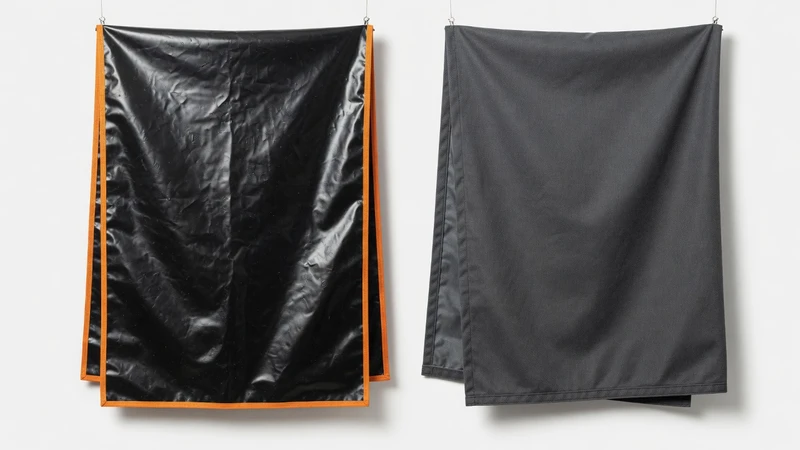
The Three-Line Spec Gap: Outdoor UV vs. Indoor Abrasion
The single most expensive assumption in forklift cover procurement is that one material works for both indoor and outdoor units in a mixed fleet. It does not.
A 600D Oxford cover with standard PU coating that protects a warehouse forklift from dust for four years will fail on an outdoor unit in eight to fourteen months. The failure mechanism is not a mystery.
It is photodegradation chemistry, and it is predictable.
Outdoor forklift covers face four simultaneous stressors that indoor covers never encounter.
First: ultraviolet radiation in the 290-400 nm range cleaves the ester bonds in polyester fibers and oxidizes PU coatings.
After 1,500 hours of accelerated UV exposure per ASTM G154 Cycle 1, standard 600D Oxford loses approximately 35-40% of its original tensile strength.
At a loading bay in southern Europe or the American Southwest, a forklift cover accumulates roughly 2,000-2,500 hours of direct UV annually. This means a standard indoor-grade cover reaches structural failure thresholds within its first year outdoors.
Second: thermal cycling stress. An outdoor forklift cover in a temperate climate experiences a 15-20°C diurnal temperature swing. Over 365 cycles per year, the differential expansion and contraction between the coating and base fabric creates micro-delamination at the weave intersections.
PVC-coated polyester handles this better than PU-coated Oxford because PVC's coefficient of thermal expansion more closely matches the polyester substrate.
Third: wind flutter fatigue. Outdoor covers in exposed yards experience wind loads that cause the fabric to pulse against the forklift body. Every pulse is a stress cycle on the seams.
A cover on a forklift in a coastal port with average 18 km/h winds accumulates roughly 1.2 million flutter cycles per year at the tie-down points. Double-stitched seams without reinforcement patches fail at the stitch holes after approximately 800,000 cycles.
RF-welded seams eliminate the stitch holes entirely and survive 2.5 million cycles at the same wind speed.
Fourth: moisture ingress with freeze-thaw cycling. Water penetrates stitch holes, expands by 9% volume when it freezes, and mechanically wedges the seam apart.
One freeze-thaw season in a region like Scandinavia or the Canadian Prairie provinces can separate a standard stitched seam by 2-4 mm along its entire length.
For a detailed technical treatment of seam durability, see our industrial equipment cover durability guide.
Indoor forklift covers face a completely different failure profile. The dominant indoor degradation mechanism is abrasion from operators leaning against the cover, forklift traffic brushing past, and dust particles embedding in the fabric weave and acting as micro-abrasives during handling.
Indoor covers also face chemical exposure from exhaust particulates in diesel forklift bays and cleaning agent overspray during floor maintenance.
For indoor use, the critical material property is abrasion resistance measured by the Martindale test (ASTM D4966). A 600D Oxford fabric with a heavy PU coating achieves 50,000+ Martindale cycles before visible wear.
A lighter 420D Oxford with a thin PU skim coat achieves roughly 15,000-20,000 cycles. The cost difference is approximately USD 1.80-2.50 per cover. The service life difference is 3-4 years versus 12-18 months.
The three lines your spec sheet must include are hence: UV stabilizer chemistry (benzotriazole-based for outdoor, not required for indoor), seam construction method (RF-welded for outdoor, double-stitched acceptable for indoor), and coating adhesion grade (minimum 80 N/5cm peel strength per ISO 2411 for outdoor covers).
Without these three lines, the factory defaults to the cheapest construction that meets the fabric denier and waterproof-rating numbers on your RFQ. That default is an indoor cover.
Material Selection for Forklift Covers: A Technical Matrix
Once you classify each forklift as outdoor-exposed or indoor-only, material selection becomes a structured decision rather than a cost comparison. The table below maps the three primary material grades used in industrial forklift cover manufacturing against their performance characteristics. All data reflects actual production specifications from our Shanghai facility.
| Material | Base Fabric | Coating | UV Life | Waterproof | Temp Range | Cost Index | Best Application |
|---|---|---|---|---|---|---|---|
| 600D Oxford + Heavy PU | 600D × 600D, 20×20 density | PU, 80-100 gsm coat weight | 800-1,000 hrs | Good (≥5,000mm) | -20°C to 80°C | 1.0x | Indoor warehouse forklifts |
| PVC-coated Polyester | 600D-1000D, 18×18 density | PVC, 200-350 gsm | 3,000-5,000 hrs | Excellent (≥10,000mm) | -30°C to 70°C | 1.4x | Outdoor yards, loading bays, ports |
| Silicone-coated Fiberglass | E-glass, plain weave | Silicone, 80-120 gsm | 5,000+ hrs | Good | -50°C to 500°C | 2.2x | Foundry, furnace charging, hot forging |
| PTFE-coated Fiberglass | E-glass, satin weave | PTFE, 100-150 gsm | 10,000+ hrs | Excellent | -70°C to 260°C | 3.0x | Chemical plants, acid fume environments |
Three ancillary material decisions that factory buyers overlook until the covers arrive and fail early:
Thread specification. Standard polyester sewing thread absorbs 0.4% moisture by weight and degrades under UV within 800-1,000 hours of direct exposure. Bonded polyester with UV inhibitor extends thread life to 3,000+ hours of UV exposure.
PTFE thread for chemical environments eliminates hydrolysis failure entirely. The thread upgrade costs approximately USD 0.10-0.20 per cover.
In our warranty claim analysis across 15,000+ units shipped, thread failure accounts for 65% of seam separations where the fabric itself was still intact.
Hardware corrosion grade. A standard brass eyelet costs USD 0.08 and corrodes in coastal salt spray within 12-18 months. A 316 stainless steel eyelet costs USD 0.35 and survives indefinite salt-spray exposure per ASTM B117 (500+ hours without red rust).
For a cover with six tie-down points, the hardware upgrade adds USD 1.62 per cover.
The labor cost to re-tie a cover that has lost its eyelets mid-season in a 40-unit outdoor fleet is roughly USD 400-600 in maintenance staff time, making the upgrade a return on investment within the first failure event.
Seam construction. A standard double-stitched seam at 3.5 stitches per centimeter works for indoor covers where water ingress is a cosmetic issue. For outdoor covers, every stitch hole is a water entry point.
RF-welded seams fuse the PVC coating layers together at the molecular level, creating a bond line that is stronger than the surrounding fabric. A welded seam costs USD 1.50-2.00 more per linear meter of seam length.
On a forklift cover with 12 meters of total seam length, that is USD 18-24 per cover. For indoor covers on a 50-unit order, double-stitching is the correct economic choice.
For outdoor covers, RF welding is the only choice that produces a waterproof cover. For a deeper explanation of seam engineering, see our Oxford fabric and seam construction guide.
MOQ, Custom Sizing, and Fleet Economics
MOQ for forklift covers is not a single number. It varies by material grade, customization level, and order mix. The structure below reflects actual production minimums at our facility:
50 units per design for standard materials: 600D Oxford with PU coating, standard colors (black, gray, navy blue), and standard hardware (brass eyelets, drawstring hem). This covers approximately 70% of first-time OEM orders we receive.
100 units per design for PVC-coated polyester with RF-welded seams. The higher MOQ reflects the welding jig setup time, which amortizes over a larger production run.
150-200 units per design for specialty configurations: custom Pantone-matched colors requiring a dedicated dye lot, silicone-fiberglass for high-heat applications, PTFE-coated fabrics, integrated clear PVC windows for dashboard and control visibility, and covers with branded screen-printing or embroidered logos.
Multi-SKU fleet orders covering different forklift classes within the same warehouse or distribution center can combine quantities across designs.
A typical order of 200 total units might include 80 covers for Class 1 electric rider trucks, 60 for Class 4 internal combustion cushion-tire trucks, and 60 for Class 5 pneumatic-tire trucks.
We apply the per-design MOQ to each forklift class but offer a blended pricing structure that reduces the unit cost by 5-12% compared to ordering each class separately.
Trial orders of 20-30 units are available at a 15-25% per-unit premium. The premium recovers pattern development labor and material procurement minimums that the smaller quantity cannot amortize.
For buyers evaluating a new supplier relationship, a trial order with a physical fit-check on the actual forklift models is the most reliable way to validate specification accuracy before committing to a fleet-wide deployment.
Custom sizing requirements. Every forklift cover we manufacture is made to your supplied dimensions. The three required measurements are:
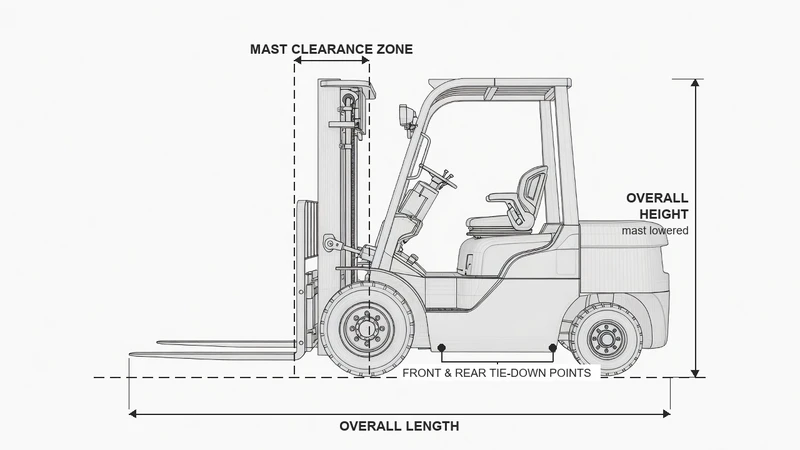
Envelope dimensions: width × depth × height of the forklift at its largest cross-section, including all projections exceeding 25 mm from the main body.
The overhead guard, exhaust stack, upright hydraulic cylinders, and any aftermarket attachments such as side-shifters or fork positioners must be captured. A good dimension sheet has a sketch with callouts for every projection.
Mast clearance: The cover must accommodate the full range of mast motion. We add a minimum of 80 mm clearance between the cover fabric and the mast at maximum lift height.
For forklifts with free-lift or triple-stage masts, we require the mast height at full extension with forks raised to confirm the clearance envelope.
Base anchoring specification: elastic hem with drawstring for light covers on indoor units, grommeted tie-downs anchored to the chassis frame for outdoor units, or magnetic strips sewn into the hem for steel-body forklifts where quick removal is required multiple times per shift.
The anchoring method is the primary determinant of wind resistance for outdoor covers.
For a complete specification template with measurement diagram examples, see our custom cover specification guide.
Four Procurement Mistakes That Cost More Than the Cover
After reviewing warranty claims, rework orders, and customer feedback across our forklift cover product line over a five-year period, four procurement errors recur with enough frequency to warrant explicit documentation. Each error is preventable at the RFQ stage with one additional specification line.
Mistake 1: Using one material spec for a mixed indoor-outdoor fleet. This accounts for approximately 40% of early-failure warranty claims we process for forklift covers.
The procurement team orders 150 covers in "600D Oxford waterproof" for a fleet that includes 60 forklifts in a climate-controlled warehouse, 50 in a covered but open-sided loading bay, and 40 parked outdoors in a yard.
Within 12 months, the outdoor units show coating delamination and seam separation. The indoor units are fine. The replacement cost for the 40 outdoor covers, including shipping and re-handling, is approximately 2.3 times the original per-unit cost for those units.
The fix: one material spec for indoor units, a different material spec for outdoor units, on the same purchase order. The factory can handle it. The price difference on the outdoor units is 30-40%.
The alternative is buying all 150 covers at the higher outdoor grade, which adds roughly USD 1,200-1,800 to the total order but eliminates the replacement event entirely.
Mistake 2: Omitting mast clearance from the dimension spec. A forklift cover dimensioned only by the overhead guard width and overall length will snag on the mast channels when the forks are raised.
The mast assembly, particularly on triplex and quad mast configurations, extends 400-600 mm above the overhead guard at full lift.
If the cover is not patterned with a clearance pocket for this extension, the mast rails pierce the cover fabric on the first lift cycle.
This failure mode accounts for roughly 25% of cover damage reported within the first month of deployment.
The fix: include mast height at full lift as a separate dimension line, and require the manufacturer to pattern a reinforced clearance pocket with a minimum 80 mm gap from the mast rails at maximum extension.
Mistake 3: Specifying brass eyelets for coastal, chemical, or high-humidity environments. Brass (copper-zinc alloy) undergoes dezincification in saline environments, where the zinc component selectively leaches out and leaves a porous copper structure that crumbles under tension.
A brass eyelet in a coastal port environment loses approximately 60-70% of its tensile strength within 18 months.
The eyelet fails at the tie-down point, the cover becomes unsecured, wind gets under the fabric, and the entire cover tears at the next gale. The failure cascade starts from a USD 0.08 component.
The fix: specify 316 stainless steel eyelets with reinforcement patches for all covers going to facilities within 10 km of a coastline, chemical processing plants, or paper mills with high ambient humidity. The hardware upgrade is USD 0.27 per eyelet.
Mistake 4: Ordering without a pre-production sample fit-check. A dimensioned sketch captures geometry.
It does not capture how the fabric drapes on a compound curve, where the forklift body transitions from the counterweight to the operator compartment, or how the cover interacts with the exhaust stack heat shield.
These are physical relationships that reveal themselves only when a sample cover is placed on the actual forklift model.
We have seen orders where the dimensions were correct to within 5 mm on paper but the cover bunched at the mast step because the pattern did not account for the chamfer angle.
A pre-production sample costs roughly USD 60-120 including courier shipping and takes 7-10 days to produce and deliver. It is the single highest-return investment in the entire OEM process.
For more on sample inspection protocols, see our custom machine cover wholesale guide.
Need Forklift Covers for Your Fleet?
Send us your forklift model list with envelope dimensions, environment classification per unit, and access requirements. We will quote within 48 hours with material recommendations at three price points and a pre-production sample timeline.
Request a QuoteReady to Source Forklift Covers from a Manufacturer That Understands Your Floor?
We have produced protective covers for industrial equipment fleets across 30 countries from our Shanghai facility.
From 50-unit trial orders for a single forklift class to 500+ unit fleet deployments spanning electric, IC, and rough-terrain trucks, send us your machine list and environment classification. We will respond with material recommendations, pricing at three budget tiers, and a production timeline within 48 hours.
Request a Quote →Frequently Asked Questions
What material is best for an outdoor forklift truck cover?
For outdoor forklift storage, PVC-coated polyester with a minimum 600D base fabric and UV-stabilized topcoat is the industry standard. The PVC coating provides a hydrostatic head rating of 10,000mm or higher for full waterproofing, while embedded UV inhibitors prevent fiber degradation.
Standard 600D Oxford with PU coating works for indoor forklifts but will lose 30-40% of its tensile strength after 12 months of continuous outdoor UV exposure.
For forklifts parked near heat sources such as furnace charging stations or foundry floors, silicone-coated fiberglass rated to 500°C continuous is required.
What MOQ should I expect when ordering forklift covers from a China OEM factory?
Standard MOQ for custom forklift truck covers is 50 units per design for 600D Oxford or PVC-coated polyester materials.
Specialized coatings such as silicone-fiberglass for high-heat environments, custom Pantone-matched colors, or covers with integrated clear vinyl windows for dashboard visibility typically require 100-200 units.
Multi-SKU fleet orders covering different forklift classes within the same warehouse can often combine quantities across designs. First-time trial orders of 20-30 units are available at a 15-25% per-unit premium.
How long does a forklift cover last outdoors versus indoors?
A properly specified forklift cover lasts 3-5 years in outdoor environments and 5-8 years in climate-controlled indoor warehouses.
The primary outdoor degradation factors are UV radiation breaking down polymer chains, wind flutter causing seam fatigue at stress points, and thermal cycling weakening fabric flexibility. Indoor covers primarily fail from abrasion and dust accumulation.
Annual inspection of stress seams, tie-down points, and coating integrity extends service life by 40-60% in both environments.
Frequently Asked Questions
Can forklift covers be custom-sized for non-standard truck models?
Yes. Every forklift cover we manufacture is made to your supplied dimensions. For reach trucks with extending masts, container handlers with elevated cabins, or rough-terrain forklifts, custom patterning is required.
We require envelope dimensions, mast clearance at full lift height, and base anchoring preference. One pre-production sample per design is shipped for physical fit-check before bulk production.
What is the most common procurement mistake when ordering forklift covers?
The most common mistake is specifying the same material for both indoor and outdoor forklifts in a mixed fleet. A 600D Oxford PU cover that works in a dry warehouse will degrade within 8-14 months outdoors.
The second most frequent error is omitting mast clearance from the dimension spec. A third common error is specifying brass eyelets for coastal environments where they corrode within 12 months; 316 stainless steel eyelets eliminate this failure.
How does the OEM wholesale process work for forklift covers?
The process follows six stages: RFQ and specification review with a 48-hour quote, pattern development and pre-production sample (7-10 days), material procurement, production with inline QC every 50 units, final AQL 2.5 inspection, and shipping.
Total lead time from deposit to FOB port is 5-7 weeks for a first order and 4-5 weeks for repeat orders. Documentation includes packing list, commercial invoice, bill of lading, and QC inspection report with photos.