Generator Cover Weatherproofing: How to Spec Protective Covers for Standby Power Equipment
A facilities manager in Houston called us last August. Their hospital had three 150 kW diesel standby generators on the loading dock, each covered with a heavy-duty tarp secured by bungee cords. When Hurricane Beryl made landfall, two covers tore loose within the first hour. Rain entered through the generator exhaust louvers. One unit flooded its control panel. The hospital ran on its third generator alone for 11 hours while maintenance crews jury-rigged protection for the other two.
The repair bill came to $18,400 in parts and labor. The generators were rated for outdoor use. The covers were not.
Generator cover weatherproofing is a spec problem, not a tarp problem. A standby generator is a six-figure asset that keeps hospitals, data centers, and manufacturing lines running during grid failures. The cover that protects it needs to match the deployment environment, the weather exposure profile, and the generator's own ventilation requirements.
This guide walks industrial buyers and procurement teams through the six-step process of specifying generator covers that survive real weather, from material selection to bulk order logistics.
Why Generator Cover Weatherproofing Matters More Than You Think
A generator that fails during a storm is worse than no generator at all. The false sense of security from an under-spec cover is the real liability. When a standby generator goes offline because its protective cover failed, the downstream cost is measured in downtime, not cover replacement.
Consider a typical 200 kW diesel standby generator. Replacement cost: $45,000 to $85,000 installed. A single control board replacement after water ingress: $3,200 to $6,800. The cover that prevents that failure costs $180 to $600 depending on material grade and size. The math is obvious, but the spec details are where most procurement teams go wrong.
Three failure modes account for 80 percent of generator cover warranty claims we see:
- UV degradation at seams. UV-stabilized fabric with non-stabilized thread means the stitching fails in 8 to 14 months while the fabric looks fine.
- Water pooling on flat surfaces. A cover without a crown or drainage slope collects water that seeps through coating micro-cracks after repeated freeze-thaw cycles.
- Wind lift at the bottom hem. A drawstring closure with a channel narrower than the cord diameter creates uneven tension. Wind finds the gap and inflates the cover like a balloon until it tears.
Each of these failures is preventable at the spec stage. They cost nothing extra to prevent, just a line item on the purchase order that most buyers never think to write. For a deeper look at how environmental exposure accelerates cover degradation, see our industrial cover durability guide.
Step 1: Determine the Deployment Environment
Generator covers need different specs depending on where the generator sits and how often it runs. There is no universal outdoor cover. Three deployment profiles cover the majority of B2B procurement scenarios:
Permanent Outdoor Installation
A standby generator bolted to a concrete pad behind a commercial building, exposed 365 days a year. This is the most demanding profile. The cover must withstand UV exposure equivalent to 2,000 to 3,000 hours of direct sunlight per year, seasonal temperature swings from -20°F to 110°F, and continuous wind exposure. Coastal installations add salt spray to the equation, requiring stainless steel hardware and corrosion-resistant coatings. Spec a cover with a minimum 3-year outdoor service life and budget for replacement every 36 to 48 months.
Portable / Construction Site Generator
A 25 to 60 kW diesel generator on a trailer, deployed to job sites for weeks at a time, then transported to the next location. The cover here faces abrasion from road debris during transport, frequent install-and-remove cycles, and occasional impact from job site activity. Abrasion resistance matters more than UV resistance. The cover should be designed for quick removal, with heavy-duty zippers or quick-release buckles, not drawstrings. Spec 600D Oxford with a double PU coating at 4 to 5 g/m² or heavier PVC tarpaulin for the base material.
Indoor Standby with Outdoor Exposure Risk
A generator housed in a mechanical room or enclosure, but the room has louvered walls or a roof vent that allows wind-driven rain entry during storms. This is a dust-and-moisture protection scenario, not full weatherproofing. A lighter 420D Oxford cover with a water-repellent finish is often sufficient. The cover primarily protects against construction dust, maintenance overspray, and occasional moisture. Budget $45 to $90 per cover at bulk quantity.
Document the deployment environment in the RFQ. Do not assume the supplier will ask. A purchase order that says "generator cover, model XYZ, outdoor" will get you a standard cover designed for a suburban backyard, not a Gulf Coast hurricane zone.
Step 2: Material Selection, 600D Oxford vs PVC Tarpaulin vs Solution-Dyed Acrylic
Material choice determines 70 percent of cover performance and roughly 55 percent of unit cost. The three materials that matter for generator covers break down by deployment severity:
600D Oxford Polyester with PU Coating
The workhorse material for generator covers. Denier rating of 600 means 600 grams per 9,000 meters of filament, giving a fabric weight of approximately 220 to 260 g/m² before coating. When paired with a PU coating at 5 to 6 g/m² application weight, this fabric achieves a hydrostatic head rating of 1,500 to 2,500 mm water column. It resists tearing at 45 to 55 N in both warp and weft directions. UV resistance is the weak point: untreated 600D Oxford loses 30 to 40 percent of its tensile strength after 1,200 hours of accelerated UV aging per ASTM G154 Cycle 1. UV-stabilized variants with titanium dioxide additives extend this to 2,000 to 2,400 hours. Cost index: 1.0x baseline. Best for: permanent outdoor deployment in moderate climates, portable generators with expected 2 to 3 year cover replacement cycles.
PVC Tarpaulin (Vinyl-Coated Polyester)
Heavier, stiffer, and more durable than Oxford. PVC tarpaulin for generator covers typically uses a 500 to 900 g/m² total weight with a polyester scrim core and PVC coating on both sides. Water column rating exceeds 5,000 mm. Cold crack resistance down to -30°C when formulated with the correct plasticizer package. UV resistance is inherent, PVC absorbs UV at the surface and sacrificial stabilizers extend outdoor life to 36 to 60 months. The trade-off: PVC tarpaulin is approximately 2.5x the cost of 600D Oxford, weighs roughly 3x as much per square meter, and requires heat-welded seams instead of sewn seams for full waterproofing. Welded seams add 15 to 20 percent to production cost but eliminate the stitch-hole leak path. Cost index: 2.5x. Best for: coastal installations, hurricane-zone standby generators, permanent outdoor units where cover replacement is logistically difficult.
Solution-Dyed Acrylic
The premium outdoor fabric. Color pigment is integrated into the acrylic fiber before spinning, so UV cannot bleach it from the surface. Solution-dyed acrylic maintains 90 percent of its original color after 3 years of continuous outdoor exposure. Water repellency comes from a fluorocarbon finish rather than a continuous coating, so it breathes while shedding rain. The breathability matters for generator covers because trapped moisture accelerates frame corrosion. The trade-off: solution-dyed acrylic costs 3.0x to 3.5x the 600D Oxford baseline, has lower tear strength (25 to 35 N vs. 45 to 55 N for Oxford), and is not suitable for high-abrasion environments. Cost index: 3.0x to 3.5x. Best for: high-end residential standby generators, rooftop installations with extreme UV exposure, applications where appearance retention matters alongside protection.
For a complete breakdown of fabric grades, denier ratings, and coating technologies across our full material range, see the custom machine cover material guide.
Step 3: Weatherproofing Specifications, UV, Water Column, Cold Crack
Three test standards separate covers that survive from covers that fail. Specify each one in the RFQ, with a pass/fail threshold, and request test reports with the pre-production sample:
UV Resistance: ASTM G154 Cycle 1
This accelerated weathering test exposes fabric samples to alternating cycles of UV light (UVA-340 lamps at 0.89 W/m² at 340 nm) and condensation at 50°C. Standard test duration is 500, 1,000, or 2,000 hours. For generator covers in permanent outdoor deployment, specify 1,000 hours minimum ASTM G154 Cycle 1 with less than 25 percent loss in tensile strength. For hurricane-zone or high-altitude installations where UV intensity is elevated, specify 1,500 to 2,000 hours. Ask for both warp and weft direction test results, fabric can degrade directionally depending on how UV stabilizers are distributed in the polymer matrix.
Hydrostatic Head: ISO 811 / AATCC 127
Measures the water pressure (in mm of water column) required to force water through the fabric. A 1,000 mm rating means the fabric resists water pressure equivalent to a 1-meter column of water before leakage. For generator covers in rain climates, specify minimum 1,500 mm. For covers that will experience wind-driven rain against vertical surfaces, specify 2,000 to 3,000 mm. For covers with horizontal top surfaces where water can pool, specify minimum 3,000 mm and add a note requiring a crowned or sloped top panel design. Test the fabric after 500 hours of UV aging, not just new. Some coatings lose 40 to 60 percent of their hydrostatic head after UV exposure.
Cold Crack Resistance: ASTM D2137 / ISO 4674
Tests the temperature at which the coated fabric cracks when folded or impacted at low temperature. For generator covers in northern climates where generators sit unused through winter, cold crack resistance is as critical as water resistance. Specify -25°C cold crack pass for cold-climate deployments, -40°C for arctic or high-altitude installations. A cover that passes hydrostatic head at room temperature but cracks at -10°C will fail the first time a maintenance technician folds it during a winter inspection. See our cold crack resistance guide for the complete testing methodology and material comparison data.
Step 4: Ventilation Cutouts and Access Panel Design
A generator cover must protect from weather without suffocating the equipment. Generators need airflow for two reasons: exhaust cooling during operation, and moisture evacuation when idle. A fully sealed cover traps condensation, accelerates rust on steel frames, and can create a microclimate inside the cover that is more corrosive than direct weather exposure.
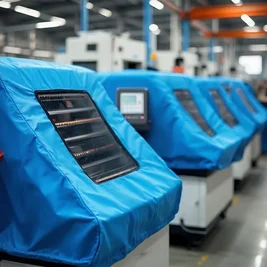
Ventilation design starts with the generator's exhaust configuration. A side-exhaust generator needs a vented panel on the exhaust side with a minimum clearance of 6 inches between the cover fabric and the exhaust outlet at operating temperature. The vent panel should use stainless steel mesh with 2 to 3 mm aperture to block debris while maintaining 60 to 70 percent open area for airflow. For top-exhaust generators, a rain cap integrated into the cover with a 45-degree sloped hood provides weather protection without restricting exhaust flow.
Access panels are the second design element. Generator covers on standby units must permit quick access for weekly test runs and monthly inspections. Two types of access systems work well in the field:
- Zippered access panels on the control panel side and the fuel fill side. Use #10 YKK coil zippers with corrosion-resistant sliders, not #5 or smaller. A #5 zipper will seize after 6 to 12 months of outdoor exposure. Two zipper pulls per panel allow opening from top or bottom.
- Quick-release buckle flaps for covers on frequently accessed generators. Side-release buckles on webbing straps hold a flap closed but release in under 3 seconds for inspection access. Specify acetal buckles rated to -30°C, not nylon, which becomes brittle in cold weather.
Condensation management is the third ventilation concern. Even with vented panels, temperature cycling between day and night creates condensation inside the cover. A small weep hole or drainage grommet at the lowest point of the cover, typically 8 to 10 mm diameter with a brass or stainless steel eyelet, allows liquid water to drain while blocking insect entry. This detail costs roughly $0.15 per cover and prevents the slow rusting that ruins generator frames over 2 to 3 seasons.
Step 5: Sizing and Fit, How to Measure for Custom Covers
A poorly fitting generator cover is worse than no cover. Wind gets under loose fabric and works it like a sail against the generator housing. Abrasion at contact points wears through the cover and the generator's paint in the same spot. A cover fit to within 2 to 3 cm tolerance on all dimensions eliminates wind lift and contact wear.
Measuring for a custom generator cover requires six dimensions, not three. Standard generator enclosures are not simple rectangles:
- Overall length (A): Longest dimension including protruding exhaust components and lifting brackets. Measure from the furthest forward point to the furthest rearward point.
- Overall width (B): Widest dimension including door handles, louvers, and external fuel line connections.
- Overall height (C): From ground/ mounting base to the highest point of the enclosure. Include the exhaust stack if it extends above the main enclosure.
- Exhaust protrusion offset: Distance from the enclosure edge to the center of the exhaust outlet. This determines vent panel placement.
- Control panel location: Distance from the nearest corner to the center of the control panel. This determines access panel placement.
- Fuel fill location: Distance from nearest edge, plus height from the base. This determines the second access panel position.
Add 3 to 5 cm clearance to all dimensions for ease of installation. More than 5 cm creates wind lift risk. Less than 3 cm makes the cover difficult to install, especially in cold weather when fabric stiffens. For generators with external fuel tanks or trailer mounts, include those dimensions and specify whether the cover should extend over the trailer tongue or stop at the enclosure edge.
Step 6: Bulk Order Considerations, MOQ, Lead Time, Customization
Bulk generator cover orders follow the same OEM workflow as other industrial covers, with a few generator-specific considerations:
Minimum Order Quantity
Standard MOQ for custom generator covers starts at 200 units per design. The per-design constraint matters: if you need covers for three generator models, each model counts as a separate design with its own MOQ. First-time orders with custom screen-printed branding typically start at 500 units to amortize screen setup costs of $60 to $80 per color. For mixed-model orders, we can often combine production runs to reduce the per-model MOQ. Contact us with your generator model list and we will quote accordingly.
Lead Time
A first-time custom generator cover order takes 5 to 7 weeks from deposit to FOB port. The timeline breaks down as: pattern making and sample approval (10 to 14 days), material procurement including custom-color dye lots (10 to 14 days), production cutting and sewing (12 to 16 days), QC inspection and packing (4 to 5 days). Add sea freight time: 14 to 16 days to US West Coast, 28 to 32 days to European ports. Repeat orders with locked patterns and material specs ship in 4 to 5 weeks.
Customization Options
Generator covers support the same customization range as our other industrial cover lines: screen printing in up to 4 colors for large runs, heat transfer for small multi-color logos, woven labels sewn into seams, custom-color drawstrings and hardware, branded polybag packaging with barcode labels, and retail-ready hang tags. Every customization option adds 3 to 7 days to the production timeline. Specify all branding requirements in the initial RFQ to avoid mid-production change orders that add cost and delay.
Material Comparison by Environment
| Material | Outdoor Permanent | Portable / Construction | Indoor Standby | Coastal / Hurricane | Cold Climate | Cost Index |
|---|---|---|---|---|---|---|
| 600D Oxford + PU | Recommended | Recommended | Over-spec | Marginal | Adequate with cold-crack spec | 1.0x |
| 600D + TPU Laminate | Better | Better | Over-spec | Adequate | Good | 2.0x |
| PVC Tarpaulin | Over-spec | Acceptable (heavy) | Over-spec | Recommended | Recommended with cold-crack spec | 2.5x |
| Solution-Dyed Acrylic | Best UV | Not suitable | Over-spec | Good | Good | 3.0x to 3.5x |
| 420D Oxford + WR | Not suitable | Not suitable | Recommended | Not suitable | Not suitable | 0.7x |
B2B Order Checklist
Use this checklist before submitting your RFQ. Each item represents a spec line that prevents a common failure mode:
- Deployment environment documented: Permanent outdoor, portable, or indoor standby with exposure risk. Include geographic region and climate data (annual rainfall, temperature range, UV index).
- Material grade specified: Fabric type, denier, coating chemistry, and coating application weight in g/m².
- Thread spec included: Bonded polyester with UV stabilizer. Explicitly prohibit nylon thread.
- UV resistance threshold set: ASTM G154 Cycle 1, minimum hours, maximum tensile strength loss percentage.
- Hydrostatic head rating specified: Minimum mm water column, tested after 500 hours UV aging.
- Cold crack temperature specified: ASTM D2137 pass temperature matched to deployment climate minimum.
- Ventilation panels detailed: Location, size, mesh aperture, drainage grommet position.
- Access panel configuration: Zipper type and size or buckle type and rating. Location relative to control panel and fuel fill.
- Six-point measurement form completed: Length, width, height, exhaust offset, control panel offset, fuel fill offset.
- Closure system specified: Drawstring channel dimensions, bungee cord diameter, or buckle configuration.
- Hardware grade specified: Stainless steel for coastal, zinc-plated for inland. Acetal buckles for cold climate.
- Branding requirements listed: Method, color count, placement, size in mm.
- Packaging spec included: Polybag, retail box, barcode, hang tag requirements.
- QC requirements defined: AQL level, inline inspection frequency, final inspection sample size.
- Target FOB price and annual volume stated: Helps our team recommend the right material grade at your price point.
Need Weatherproof Generator Covers for Your Fleet?
Send us your generator models, deployment environments, and target volume. We will quote within 48 hours with material recommendations at three price points.
Request a QuoteReady to Spec Generator Covers?
Our production team has manufactured protective covers for standby power equipment across three continents. From single-model OEM runs to multi-model fleet orders, we deliver covers that match your climate, your generator, and your procurement timeline.
Request a Quote →Frequently Asked Questions
Can I order generator covers for multiple generator models in a single production run?
Yes. We run mixed-model production batches where covers for different generator models share the same material and hardware spec. This reduces the per-model MOQ from 200 units to as low as 50 units per model when the combined order reaches the total MOQ threshold. Mixed-model runs add 3 to 5 days to pattern-making time but reduce per-unit cost for buyers managing diverse generator fleets.
How do I verify the material grade after delivery?
Request a material certification sheet with each shipment. This document lists the fabric denier, coating chemistry, coating weight, and test results for the production lot. For independent verification, a textile testing lab can run denier count, coating weight analysis, and hydrostatic head testing on a cover sample for approximately $150 to $250 per test. We include material cert sheets as standard with every OEM order over 500 units.
What is the warranty on custom generator covers?
Our standard warranty covers material defects and workmanship for 12 months from the bill of lading date. UV degradation is covered within the stated ASTM G154 test parameters: if we specify 1,000 hours UV resistance and the cover shows excessive degradation at 700 hours of equivalent outdoor exposure, that is a covered material defect. We recommend field-testing the pre-production sample for one full season before committing to the bulk order, especially for new generator models or extreme deployment environments.
Frequently Asked Questions
Who is this guide for?
Facilities managers, procurement teams, and equipment distributors sourcing weatherproof protective covers for standby and portable generators in industrial, commercial, and institutional settings.
Who should NOT use custom generator covers?
Operations where generators run continuously and covers cannot be removed during operation. Also not suitable for generators permanently housed in climate-controlled indoor rooms with no weather exposure risk.
What does a custom generator cover typically cost?
Industrial-grade generator covers range from $80 to $600+ per unit depending on generator size (25 kW portable vs. 500 kW standby), material grade (600D Oxford vs. PVC tarpaulin), and order quantity. MOQ starts at 200 units per design.
How long does a quality generator cover last?
With proper material selection: 600D Oxford with UV-stabilized PU coating lasts 24 to 36 months in permanent outdoor deployment. PVC tarpaulin with welded seams lasts 36 to 60 months. Solution-dyed acrylic lasts 36 to 48 months with better color retention.
Can generator covers be used while the generator is running?
Generally no. Generator covers are designed for standby protection. Running a generator with its cover on creates fire risk from exhaust heat and restricts cooling airflow. Our covers are designed for quick removal before operation using zippered panels and quick-release buckles.
What should I check before placing a bulk order?
Verify material specs against your deployment climate (ASTM G154 for UV, ISO 811 for water column, ASTM D2137 for cold crack). Confirm ventilation panel placement matches your generator's exhaust and control panel layout. Always request and field-test a pre-production sample.