How to Spec a Custom Industrial Equipment Cover
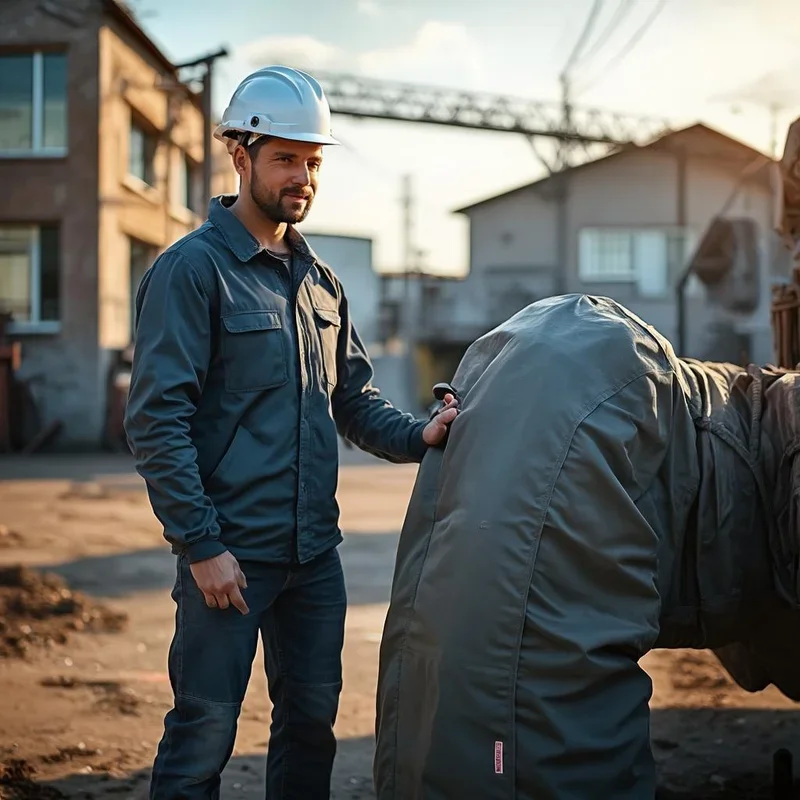
A protective cover looks simple until the first sample doesn't fit. Then you re-measure, re-quote, and lose three weeks. This guide is for buyers who want to write one spec, get one accurate quote, and one sample that fits the first time.
It walks through the seven decisions that decide whether a cover protects your equipment or just covers it.
Why Most Equipment Cover Specs Fail at the Sample Stage
Most failed specs aren't wrong on material. They're wrong on dimensions and features. We see it weekly: a buyer sends a photo and a rough size, we build the sample, and the cover is 3 cm too short or the access panel is on the wrong side.
A cover that fits a machine parked in a warehouse fails the same machine loaded on a truck. Define the environment first, then the measurements.
Dimension First: Measure the Machine, Not the Space
Measure the widest point, the tallest point, and the deepest point, not the footprint on the floor. A machine with a protruding control arm needs that arm in the measurement. Add 2–3 cm of clearance per side for a cover that goes on and off without tearing.
Take a recent RFQ we handled: a unit 152 cm long, 91 cm wide, 183 cm tall, bottom open. Five panels (front, back, two sides, top) come to roughly 10 m² of fabric. Bottom open means no floor panel, so four corner straps hold the cover down instead.
State the bottom clearly: open, closed, or elastic-cinched. "Open bottom with corner straps" is a different cover from "fully enclosed." Different cut, different hardware, different price.
Fabric: What "600D Oxford" Actually Means
You'll see "600D Oxford" on most outdoor cover specs. The "D" is denier, a measure of fabric weight, like bedsheet thread count. Higher denier, heavier material. 600D with a PU coating is the workhorse for covers that sit outdoors year-round.
| Denier | Weight | Best For |
|---|---|---|
| 210D Oxford | Light | Indoor dust covers, short-term storage |
| 420D Oxford | Medium | Mid-range, seasonal outdoor use |
| 600D Oxford + PU | ~300 g/m² | Outdoor equipment, year-round exposure |
| 1680D / PVC | Heavy | Heavy abrasion, chemical, high-temperature |
We manufacture from 210D to 1680D Oxford polyester, plus PVC and TPU. Coating matters as much as denier. PU is the standard, PVC and silicone for chemical or high-temperature exposure. See the Oxford fabric guide for the full breakdown.
Ask for the gram weight, not just the denier. 600D Oxford with PU coating runs about 300 g/m². A factory that can't quote gram weight is guessing. If the cover has to meet flame resistance, demand ASTM E84 or NFPA 701 documentation. Never take a verbal yes.
Access Features: Zippers, Windows, Straps, and Where They Go
This is where specs die. A cover is not a bag. Every feature has a position, and the position has to match how the machine is used.
Three features drive most custom specs, and each needs a position, not just a yes:
- Zipper. A front double zipper lets an operator open the cover from either end. Specify the run length and whether it's waterproof. A 183 cm-tall cover needs a zipper run that long.
- Observation window. A transparent PVC panel lets someone check a gauge without removing the cover. Specify size and position. A typical callout is a 40 × 50 cm window, 45 cm from the top, 20 cm from the front edge, on the right side. Window thickness runs 0.3–0.5 mm; 0.5 mm survives more handling.
- Straps. Four corner straps with side-release buckles hold an open-bottom cover to the machine. Specify strap length so the buckle lands where the operator can reach it.
Every position you don't specify is a position the factory guesses.
Logo and Branding: One Color, One Position, One File
Single-color logo is the lowest-cost and cleanest: silkscreen or heat transfer, one position, one color. Multi-color means setup cost and a longer sample round.
Send vector art, not a screenshot. Use AI, EPS, or PDF. A low-resolution PNG scaled up prints blurry on fabric, and you'll pay for a redo. State the finished size in centimeters, not "about this big."
Packaging and Freight: The Line Item That Eats Margin
Packaging is where quiet money leaks. A cover that ships loose costs more in freight than one packed flat.
A 152 × 91 × 183 cm cover, once folded, compresses to roughly 61 × 45 × 25 cm and about 3.5 kg. Folded tight, you fit 2–4 units per export carton. Loose, you fit one, and pay freight on the air.
Specify it: individual PE bag, carton quantity, folded size. Don't leave packaging to the factory's default. Exact folded size and carton count should be confirmed on the first sample. One more reason to sample before committing to a volume quote.
MOQ, Lead Time, and Why Samples Come First
Custom covers carry a minimum order quantity because cutting and setup cost the same for one unit as for fifty. MOQ runs 100–500 units depending on complexity; simpler designs start at 50. Production lead time runs 25–40 days, with samples in 7–10 working days after the drawing is confirmed.
Sample first. Always. The sample is where you verify fit, zipper position, window placement, and fabric feel, before you pay for 500 units. A sample costs a fraction of a re-run and is usually credited against the production order.
When a Custom Cover Isn't Worth the Tooling
Custom isn't always the answer. If your machine matches a stock size and you don't need a window, logo, or specific access, a stock cover saves the setup cost.
Not for: one-off units with no repeat volume. Tooling and sample alone outweigh the unit savings. Not for: food-contact or medical applications without FDA-grade or certified material specified up front.
The decision is repeat volume. One cover, buy stock. Fifty covers a year, custom pays for itself.
Frequently Asked Questions
What material is best for a custom industrial equipment cover?
For outdoor equipment, 600D Oxford with a PU coating is the workhorse, about 300 g/m², waterproof and UV-resistant. For heavy abrasion or chemical exposure, step up to PVC-coated polyester or a TPU/silicone coating. For indoor dust-only protection, 210D polyester is lighter and lower-cost.
What is the minimum order quantity for custom equipment covers?
MOQ runs 100–500 units depending on design complexity. Simpler designs can start at 50 units. Cutting and setup cost the same for one unit as for fifty, which is why custom covers carry a minimum.
How long does it take to make a custom equipment cover?
A pre-production sample takes 7–10 working days after the drawing is confirmed. Production lead time runs 25–40 days depending on quantity and material. Always approve a sample before committing to volume.
The Short Version
Measure the machine, not the space. 600D Oxford with PU coating is the outdoor workhorse. Ask for gram weight. Put every zipper, window, and strap in a position. Pack flat and confirm folded size on the sample. Sample before you commit to volume.
A custom cover is a tailored suit, not an off-the-rack one. It fits your machine, not a machine like yours. The analogy stops there: fit is only the first requirement. Material, coating, and hardware decide whether it still fits two years from now.
For a deeper look at material and durability, see our industrial cover durability guide and the equipment covers product page.