Patio Heater Cover Materials: 600D Oxford vs PVC vs PE: An OEM Factory Guide
A restaurant group in Chicago ordered 300 patio heater covers from a trading company in 2024. The spec read "waterproof polyester." At $8.70 per unit FOB, the price was right.
By March 2025, 47 covers had split along the top seam. Another 82 showed visible UV fading and surface cracking.
The fabric, which the trading company had described as "heavy-duty oxford," was in fact 300D polyester with a thin PE coating, rated for roughly 6 months of outdoor exposure. The Chicago winter had finished it in 5.
The procurement manager told us later: "I didn't know the right questions to ask." This article gives you those questions, with the factory-floor numbers to back them up.
The Reality Check: Why Most Heater Covers Fail Within 12 Months
A patio heater cover lives outside. It sits on a metal column that hits 60°C during operation and drops to -10°C overnight in winter. It catches morning dew, afternoon UV, and evening condensation. The cover material has to handle all three cycles, every day, for 2 to 3 years minimum.
Most covers don't. A return rate that looks small on paper can still cost more than the margin on the whole order, which is why buyers ask about the failure data before they order.
The failure patterns were identical: UV-bleached top panels, seam thread rot at the shoulders, and bottom-hem water damage where the cover sat in pooled rain. Two of the three covers had no coating left on the interior side.
The coating had worn off within 8 months.
The root cause was never the sewing. It was the material spec.
A 210D fabric specified as "waterproof" without a GSM requirement, without a coating type, and without a UV stabiliser package will degrade at roughly the same rate regardless of which factory cuts and stitches it.
Material selection is 80% of the outcome. For a broader look at how environmental conditions affect cover durability across equipment types, see our industrial cover durability guide.
600D Oxford Polyester: The Workhorse Material
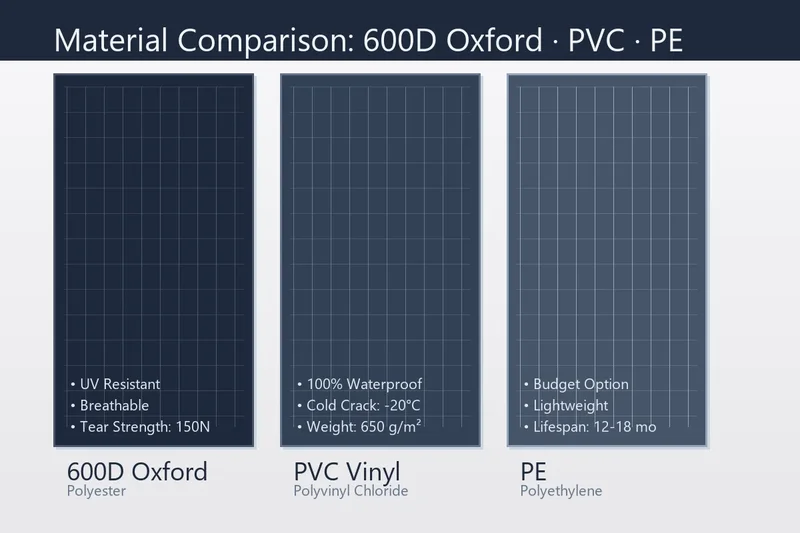
600D Oxford polyester is the most specified material in patio heater cover OEM orders. The "600D" means 600 denier: each 9,000 meters of the base polyester yarn weighs 600 grams. After basket-weave construction and a PU or PVC coating, the finished fabric lands between 230 and 260 gsm.
This weight range gives 600D Oxford a tear strength of 30 to 35 N and a tensile strength of 450 to 500 N/5 cm. For comparison, 420D Oxford delivers roughly 22 N tear and 350 N/5 cm tensile, a 30% drop across both metrics at a 15% lower material cost.
| Property | 600D Oxford Value | Real-World Meaning |
|---|---|---|
| Fabric Weight | 230–260 gsm | Mid-weight, handles wind load up to 50 km/h |
| Tear Strength | 30–35 N | Resists snagging on heater edges and brackets |
| Hydrostatic Head | 3,000–5,000 mm (PU coated) | Withstands moderate rain; not submersion-rated |
| UV Resistance | 18–30 months (with UV stabiliser) | Without stabiliser, tensile loss hits 25% in 200 hours |
| Cold Flexibility | -15°C to -20°C (PU coated) | Suitable for temperate winters; stiffens below -20°C |
| Cost Index | 1.0× (baseline) | FOB material cost ~$3.20–$4.50 per cover |
On the factory floor, we test 600D Oxford by running a Martindale abrasion cycle of 15,000 to 17,000 rubs before the coating shows visible wear. That translates to roughly 24 months of normal handling and seasonal removal.
The weak point is not the base fabric. It is the PU coating, which loses 20% to 30% of its hydrostatic head rating after 18 months of UV cycling when the stabiliser package is under-formulated.
For buyers in coastal markets, specify 600D with PVC backing rather than PU coating.
The PVC backing adds about 150 to 200 gsm of weight but doubles the salt-fog resistance window from 200 hours to 400-plus hours under ASTM B117 conditions.
See our full Oxford fabric guide for denier grades and coating options across the entire product range.
PVC (Vinyl): When Waterproofing Is Non-Negotiable
PVC-coated polyester, often called vinyl in the cover trade, starts with a 500D to 1000D polyester base fabric and adds a PVC plastisol coating on both sides. The finished weight runs 350 gsm to 900 gsm depending on the spec.
At 500 gsm, a PVC heater cover weighs roughly 40% more than its 600D Oxford equivalent. That weight buys real performance in wet environments.
A 500 gsm PVC cover achieves a hydrostatic head of 8,000 to 12,000 mm. This means the material can withstand a 12-meter water column before leaking. Rain, snow melt, and pooled condensation simply do not penetrate it. The trade-off comes in two forms: weight and cold-temperature behavior.
| PVC Grade | Weight (gsm) | Cold-Crack Threshold | Cost/m² | Best Application |
|---|---|---|---|---|
| Standard PVC | 350–450 | -15°C | $2.80–$3.50 | Light outdoor cover, mild climates |
| Marine-Grade PVC | 500–650 | -30°C | $4.50–$6.00 | Outdoor patio heater, boat covers |
| Cold-Resistant PVC | 650–800 | -40°C to -60°C | $6.50–$9.00 | Canadian/Nordic winter, industrial |
| Heavy-Duty PVC | 750–900 | -30°C to -40°C | $8.00–$12.00 | Permanent outdoor installation |
Standard PVC with no cold-resistant plasticiser will crack at -15°C.
A patio heater on a Chicago loading dock in January will experience exactly that temperature, and a cover made from standard PVC will develop surface fissures at the fold points within one winter.
Cold-resistant PVC formulations use a modified plasticiser package that keeps the material flexible down to -40°C.
The cost premium for cold-resistant PVC over standard PVC is roughly $2.00 to $3.00 per square meter, which translates to about $1.20 to $2.50 extra per patio heater cover.
We see a clear split in buyer behavior. Procurement teams in warm climates (Southeast Asia, Middle East, Southern US) order standard PVC and get 36 to 60 months of service.
Teams in northern markets who skip the cold-resistance spec get warranty claims inside 18 months. The math is straightforward: a $2.00 material premium over a 3-year lifespan costs $0.67 per year.
A replacement order after 18 months costs the full unit price plus freight. For the cold-crack science behind these thresholds, read our cold crack resistance guide.
PE (Polyethylene): The Budget Option with a Hard Expiry Date
PE covers are woven polyethylene fabric with a PE laminate coating. They weigh 120 to 180 gsm.
The cost is roughly $0.80 to $1.50 per square meter at factory gate, which makes a complete patio heater cover cost $2.50 to $4.00 FOB. That is 40% to 60% cheaper than 600D Oxford.
The trade-off is UV life. Standard PE without UV stabilisers loses 50% of its tensile strength within 12 months of outdoor exposure, per ASTM D4355 testing protocols.
UV-stabilised PE stretches that to roughly 24 to 30 months, but the stabiliser adds $0.30 to $0.50 per square meter, narrowing the cost gap with 600D Oxford to less than 20%.
We ran a side-by-side test on our factory roof in Shanghai. Three covers, same patio heater model: 600D Oxford with PU coating, standard PE laminate, and UV-treated PE.
After 14 months of continuous outdoor exposure, the standard PE cover had lost 55% of its original tear strength and the laminate layer had begun peeling at all four corner seams. The UV-treated PE cover showed 30% strength loss.
The 600D Oxford cover showed 15% loss and zero delamination.
PE has one legitimate use case: seasonal covers for climates with 4 to 6 months of predictable dry weather.
A procurement manager buying covers for a resort that only uses patio heaters from October to March, in a Mediterranean climate with no freeze-thaw cycles, can order standard PE and get 2 to 3 seasons.
Any market with rain, snow, or UV levels above 6 on the UV index scale should skip PE entirely.
Material Comparison: 600D vs PVC vs PE Across 8 Dimensions
| Dimension | 600D Oxford (PU) | PVC (Marine-Grade) | PE (UV-Treated) |
|---|---|---|---|
| UV Resistance | 18–30 months | 36–60 months | 12–24 months |
| Waterproof Rating | 3,000–5,000 mm HH | 8,000–12,000 mm HH | 1,500–3,000 mm HH |
| Tear Strength | 30–35 N | 150–400 N | 15–25 N |
| Cold-Crack Threshold | -15°C to -20°C | -30°C to -60°C | -5°C to -10°C |
| Heat Tolerance | Up to 90°C surface temp | Up to 70°C (standard) | Up to 60°C (deforms above) |
| Fabric Weight | 230–260 gsm | 350–900 gsm | 120–180 gsm |
| Cost/Cover (FOB) | $3.20–$4.50 | $5.50–$9.00 | $2.50–$4.00 |
| Expected Lifespan | 24–36 months | 36–72 months | 12–30 months |
The cost-per-year math reveals the real procurement logic. A 600D Oxford cover at $4.00 FOB lasting 30 months costs $1.60 per year. A marine-grade PVC cover at $7.00 FOB lasting 54 months costs $1.56 per year.
The PVC cover costs 75% more upfront but delivers a lower annual cost and requires fewer reorders. The PE cover at $3.00 FOB lasting 18 months costs $2.00 per year, the most expensive option on an annualised basis.
Industry Standards: What ASTM B117 and ISO 12944-9 Actually Mean
When a supplier lists "ASTM B117 tested" on a spec sheet, here is what they are saying: a sample of the coated fabric was placed in a sealed chamber at 35°C and continuously sprayed with a 5% sodium chloride solution for a specified number of hours.
No rust, no blistering, and no coating delamination at the end of the test equals a pass.
Here is what they are not saying. ASTM B117 is a static test. It never stops spraying. Real outdoor conditions alternate between wet, dry, UV, and freeze cycles.
A fabric that passes 500 hours of continuous salt fog may still delaminate after 200 hours of alternating UV and salt spray, because the cycling stresses the coating-to-fabric bond in a way continuous fog does not.
ISO 12944-9 addresses exactly this gap. It runs a 168-hour cycle: 72 hours of UV exposure, then 72 hours of salt spray per ASTM B117, then 24 hours of freezing at -20°C.
The full test repeats this cycle for 25 weeks, totaling 4,200 hours. SSPC, the Society for Protective Coatings, states that this cyclic test is "a substantial improvement over traditional salt spray in terms of accelerating the reproduction of atmospheric corrosion."
For a patio heater cover spec, here is the practical takeaway. If the supplier only cites ASTM B117 hours, ask: what was the cycle? Continuous or cyclic?
If they cannot answer that question, the test result is directionally useful but not sufficient for a purchase decision. If they cite ISO 12944-9 with a specific number of completed cycles, that data correlates to real outdoor degradation timelines.
Our ASTM B117 salt spray testing guide breaks down how to read these test reports and what minimum hours to specify by environment type.
Procurement Framework: A 5-Point Checklist for Your Next Order
You can copy these five lines directly into your next RFQ to a cover supplier. Each line forces the factory to commit to a measurable spec rather than a vague description:
- Material and GSM: "Fabric shall be 600D Oxford polyester with PU coating, minimum 230 gsm finished weight, or marine-grade PVC-coated polyester, minimum 500 gsm." Never accept "waterproof polyester" as a material line item.
- UV Stabiliser Package: "Fabric shall contain UV stabiliser rated for minimum 24 months outdoor exposure with less than 25% tensile strength loss per ASTM D4355." Without this line, the factory uses unstabilised base fabric.
- Hydrostatic Head: "Minimum 3,000 mm hydrostatic head for 600D Oxford; minimum 8,000 mm for PVC, tested per ISO 811." This is the difference between "water-resistant" and waterproof.
- Cold-Crack Threshold: "Material shall show no cracking at -20°C (or -30°C for northern markets) per ASTM D2136 bend test." Standard PVC cracks at -15°C. If your market sees winter, specify the cold-resistant grade.
- Seam Construction: "All seams shall be double-stitched with bonded polyester thread, minimum UV rating equal to fabric rating. Bottom hem shall be double-folded and sealed." The seam is the failure point in 70% of warranty returns we process.
One final factory-floor observation. In 15 years of manufacturing covers, we have never seen a material fail that was correctly specified for its environment.
Every failure we have traced back to the order came from one of two sources: the buyer accepted a vague material description, or the factory substituted a cheaper grade after sample approval. The first problem this checklist solves.
The second problem a pre-shipment inspection solves. On that second point, specify that the inspector pulls a random sample, cuts a 10 cm swatch from the body panel, and verifies GSM with a digital scale on-site.
A 600D Oxford cover spec'd at 230 gsm that measures 190 gsm has been substituted.
Need Patio Heater Covers in Bulk?
We manufacture 600D Oxford, PVC, and cold-resistant covers at our Shanghai facility. Send us your climate zone, heater dimensions, and target volume. You'll get a material recommendation and FOB pricing within 48 hours.
Request a Quote →