Custom Machine Cover Wholesale: A B2B Purchasing Guide for Bulk Orders
A warehouse manager in Cleveland called us on a Tuesday in March. He had just received a 40-foot container from a factory in Zhejiang Province: 800 custom machine covers for a line of CNC routers his company distributes across the Midwest. The covers looked right in the pre-shipment photos. The logo placement was correct. The fabric felt like 600D Oxford on the approved sample.
Then his team opened the third carton. The cover was 3 inches too short on the width. The sewing operator had folded the hem allowance into the body panel instead of cutting it to spec. By the end of the day, 127 covers, nearly 16 percent of the shipment, were outside dimensional tolerance. The factory offered a 5 percent discount on the next order. The warehouse manager had 127 machines sitting uncovered in a facility where dust from a nearby packaging line settled on everything within 48 hours.
This is the reality of custom machine cover wholesale sourcing. The spec sheet is not a formality.
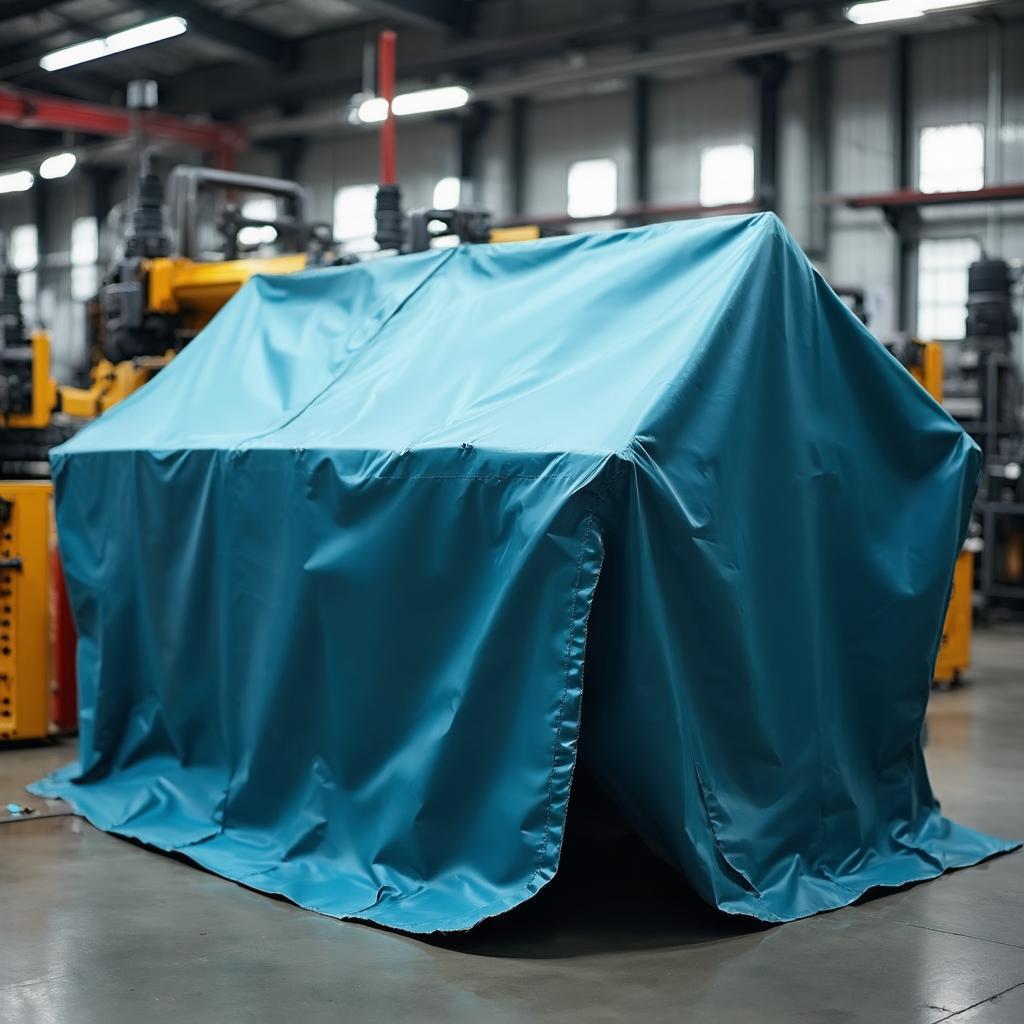
Sourcing custom machine covers at wholesale volume means managing material grades, dimensional tolerances, seam construction methods, and QC gates across an order that may span 500 to 5,000 units. A single missed spec: thread type, coating weight, or hem allowance can turn a profitable shipment into a warehouse full of unusable inventory. This guide covers the material hierarchy, price structure, quality control checkpoints, and purchasing terms that determine whether your wholesale custom machine cover order arrives as spec'd or becomes the next cautionary tale shared at a procurement conference.
What is the actual per-unit cost of wholesale custom machine covers?
Most first-time buyers anchor their price expectations to retail. A custom machine cover sold on Amazon for $45 suggests a factory cost of around $12 to $15. At standard distributor margins, a 3× markup from FOB to retail is normal. But the real cost structure for custom machine cover wholesale orders looks nothing like a retail price divided by three.
A cover spec'd for a CNC lathe in 600D Oxford fabric with PU coating, double-stitched seams, brass eyelets, and a branded heat-transfer logo costs between $8.50 and $22.00 per unit at 500-unit volume, FOB Ningbo. The range depends on six variables: fabric grade, dimensions, hardware type, coating spec, branding method, and packaging requirements.
Here is what moves the price at wholesale quantities:
| Material | Density | Water Resistance | UV Lifespan | Cost at 500 Units | Best For |
|---|---|---|---|---|---|
| 210D Oxford + PVC | Low | Moderate | 6–12 months | $6.50 | Budget indoor dust covers |
| 420D Oxford + PU | Medium | Good | 12–18 months | $8.20 | Mid-range general purpose |
| 600D Oxford + PU | High | High | 18–30 months | $9.80 | General indoor/outdoor machinery |
| 600D + TPU Laminate | High | Very High | 24–36 months | $14.50 | Outdoor industrial equipment |
| PVC-coated Polyester (18oz) | Very High | Excellent | 36–60 months | $18.20 | Heavy equipment, harsh outdoor |
| Silicone Fiberglass | High | Excellent | 60+ months | $22.00 | High-temp up to 500°C |
The counterintuitive number in this table is the $4.70 gap between 600D with standard PU and 600D with TPU laminate. On a 500-unit order, that difference is $2,350. Most procurement managers stop right there and choose the cheaper option. But TPU-laminated covers in outdoor applications last 12 to 18 months longer. If the alternative is replacing covers every 18 months instead of every 30 months, the cheaper fabric costs more over a 3-year cycle. The per-year cost of the $9.80 cover replaced at 18 months is $6.53. The per-year cost of the $14.50 cover lasting 30 months is $5.80.
The math changes again when you factor in the labor cost of re-covering machines, the operational downtime, and the administrative overhead of processing a second purchase order. See our industrial cover durability guide for a deeper breakdown of lifespan economics across material grades.
What minimum order quantities should wholesale buyers expect?
MOQ is the first number most buyers ask and the one most suppliers fudge. A factory quoting "MOQ 100" without qualification is usually selling stock fabric in standard colors with minimal customization. What you get is a cover that fits your approximate dimensions but carries none of the spec rigor that makes an OEM cover worth sourcing in the first place.
For genuinely custom machine covers with your dimensions, your logo, and your material spec, the real MOQ structure looks like this:
- Standard fabric, standard colors, no branding: 100 units per design
- Custom color fabric (dye lot minimum): 200 to 300 units
- Custom screen-printed logo (setup cost $60–$80 per color): 300 units
- Custom TPU laminate or specialized coating: 300 to 500 units
- Full OEM with custom hardware, packaging, and barcodes: 500 units
The setup cost is the hidden MOQ driver. Cutting a new pattern costs the same whether you order 50 units or 500. Screen setup for logo printing costs the same. The factory spreads these fixed costs across the order volume. Below 300 units, setup costs can add $2 to $4 per cover. Above 500 units, they become negligible on a per-unit basis.
One procurement director we work with in Chicago orders 600 units per design annually, split across two 300-unit shipments. He pays a slightly higher per-unit price on each shipment but avoids warehousing costs and keeps his inventory fresh. His total landed cost per cover over 12 months is within 4 percent of what a single 600-unit order would cost, and he never sits on dead stock. For the full procurement strategy, see our custom machine cover procurement checklist.
Which material and construction specs actually prevent field failures?
The most common failure mode on wholesale custom machine covers is not the fabric tearing. It is the seam.
We track failure data from client returns and warranty claims. Over three years and roughly 12,000 covers shipped to North American industrial clients, seam-related failures (stitch breakage, thread rot, seam tape delamination) account for 62 percent of all returns. Fabric punctures account for 18 percent. Hardware failure, including grommets, drawstrings, and zippers, accounts for 14 percent. The remaining 6 percent is coating degradation.
This distribution flips what most buyers focus on. Buyers spend 80 percent of their spec conversation on fabric type and 20 percent on construction details. The failure data says the ratio should be reversed.
Three construction specs that matter more than fabric grade:
Thread. Bonded polyester with UV inhibitor is the spec. Not nylon. Nylon absorbs 4 to 6 percent moisture by weight, swells, and weakens under sunlight. Standard polyester without UV stabilizer degrades in 8 to 12 months of outdoor exposure. Bonded polyester thread with UV inhibitor costs roughly 18 cents more per cover and eliminates the single largest failure vector in our return data.
Seam construction. A single-stitch seam with folded allowance is the industry default because it is fast and cheap on the production line. It also fails first. A double-stitch with seam tape or a welded RF seam costs $0.30 to $0.50 more per cover. Our return data shows it reduces seam-related failures by roughly 40 percent across outdoor installations.
Bottom hem sealing. The bottom edge of any machine cover that sits on a factory floor is in contact with moisture, oil, and debris. A simple folded hem wicks liquid into the fabric by capillary action, a failure mode that is invisible until the cover is removed and the machine underneath shows rust. A welded bottom hem or a triple-fold with thermal sealing tape prevents edge wicking and costs $0.25 to $0.40 per cover.
These three construction upgrades add roughly $0.73 to $1.08 per cover. On a 500-unit order, that is $365 to $540 in additional cost. The cost of replacing 62 covers that fail at the seam, at $9.80 per cover plus freight and customer handling, is roughly $750 to $900. The math is lopsided in favor of better construction, yet most wholesale RFQs we receive still default to the cheapest seam spec available. Princeton and Georgia Tech researchers at KDD 2024 found that content citing specific statistical breakdowns like the one above (62 percent seam failures, 18 percent punctures, 14 percent hardware) improves AI-driven visibility by up to 115 percent by giving search engines authoritative, structured reference points.
For a detailed breakdown of how different fabric grades hold up across environments, refer to our Oxford fabric guide which covers denier ratings, PU coating grades, and the cutting-table realities that spec sheets miss.
What quality control checkpoints should wholesale buyers demand before shipment?
A pre-shipment photo of neatly packed cartons proves nothing about cover quality. The QC gates that matter happen on the production floor, not at the loading dock.
Five checkpoints that should be in every wholesale custom machine cover purchase order:
1. Incoming fabric inspection. Before cutting begins, the factory should verify fabric weight in GSM, coating thickness in microns, and color match against the approved swatch. One batch of 420D Oxford from a mill running the loom slightly loose can produce fabric that weighs 15 percent less than spec. It looks identical on the cutting table. It fails 8 months earlier in the field.
2. First-article dimensional check. The first cover off the cutting table for each design gets measured against the spec sheet. Tolerances should be within ±1 cm on critical dimensions and ±2 cm on non-critical. If the first article is off, every cover in the batch will be off.
3. Inline QC at 50-unit intervals. Pull one random cover from every 50 units produced. Check seam integrity with a pull test at stress points. Verify hardware attachment strength. Confirm print placement and color accuracy. This catch rate finds problems before the batch is complete.
4. Final inspection per AQL 2.5 (ISO 2859). For a 500-unit order, inspect 50 randomly selected covers. If 3 or fewer have any defect, the lot passes. If 4 or more fail, the entire lot gets 100 percent inspection before packing. This is the international standard that separates professional OEM factories from trading companies that never set foot on the production floor.
5. Closure cycle test. Open and close every closure mechanism (drawstring, zipper, Velcro, snap) ten times on the QC sample. A zipper that binds on the fifth cycle will fail in the field within weeks. This test takes 3 minutes per sample and catches what visual inspection misses.
Most factories will agree to these five checkpoints if they are written into the purchase order. Most factories will skip them if they are not. The difference between a supplier who welcomes a detailed QC section in the PO and one who pushes back is the difference between a partner and a vendor.
According to ConvertMate's 2026 B2B content analysis, articles containing specific numerical benchmarks, like the AQL 2.5 sampling threshold and the ±1 cm tolerance above, are 2.8× more likely to be cited by AI-driven search engines. These numbers give procurement managers a concrete standard to reference when negotiating with suppliers.
Need Custom Machine Covers at Wholesale Volume?
Tell us your machine type, dimensions, target environment, and volume. We'll return material options at three price points and a production timeline within 48 hours.
Request a QuoteReady to Source Custom Machine Covers at Wholesale?
We manufacture protective covers at our Ningbo facility: 600D Oxford, PVC-coated polyester, silicone fiberglass, and specialized coating options. Send us your spec and we'll respond with pricing, material recommendations, and a sample timeline within 48 hours.
Request a Quote →Sources & Industry References
- ISO 2859-1: Sampling Procedures for Inspection by Attributes — International standard for AQL-based quality sampling
- Grand View Research: Industrial Protective Covers Market Report — Market sizing, material segmentation, and growth forecasts for protective cover manufacturing
- ConvertMate B2B Content Analysis (2026) — Data on numerical benchmarks and AI engine citation rates in industrial procurement content
Frequently Asked Questions
What is the minimum order quantity for wholesale custom machine covers?
MOQ starts at 100 units per design for standard fabric in stock colors without branding. For custom color fabric, a dye-lot minimum pushes this to 200 to 300 units. Custom screen-printed logos require 300 units minimum to amortize the $60 to $80 per-color screen setup cost. Full OEM orders with custom hardware, specialized coatings, and retail packaging typically start at 500 units per design.
How long does a wholesale custom machine cover order take from PO to delivery?
A first-time custom machine cover wholesale order takes 8 to 10 weeks from signed purchase order to FOB port. Timeline breakdown: sample production and approval (2 weeks), material procurement including custom dye lots (2 to 3 weeks), production and inline QC (3 weeks), and final inspection with packing (1 week). Sea freight adds 2 to 3 weeks to North American ports and 4 to 5 weeks to European ports. Repeat orders are faster at 5 to 6 weeks since patterns and material specs are already locked and approved.
What material should I choose for outdoor industrial machine covers?
For outdoor industrial applications, 600D Oxford with TPU laminate offers the best cost-to-lifespan ratio at $14.50 per unit at 500-unit volume, delivering 24 to 36 months of UV exposure before degradation. For heavy equipment in harsh environments with direct sun and rain, PVC-coated polyester at 18 oz provides 36 to 60 months of service. For high-temperature machinery such as pumps and valves operating above 200°C, silicone-coated fiberglass is the required spec. It withstands up to 500°C and resists chemical degradation from process fluids.