A cover that works fine on a heated factory floor can fail within one season in a freezer room or on a construction site in January. Cold storage environments are a different problem: below-freezing temperatures, condensation, frost, and the constant cycling between cold and warmer air.
This guide is written for equipment managers and procurement teams who need covers for cold storage compressor units, outdoor winter-stored machinery, cold-chain equipment, and frozen food processing lines. It covers what the cold actually does to covers, how to match a material to your scenario, and the specifications to put on your RFQ.
Why Freezing Environments Are Hard on Covers
The first risk is material brittleness. Most fabrics lose flexibility as temperature drops, and a stiff cover cracks under wind load, installation stress, or simple handling. This is the cold crack problem, and it applies to every component, not just the outer fabric. Zippers, buckles, and stitching thread all have their own low-temperature limits.
The second risk is moisture. Equipment inside a cold room or parked outdoors in winter accumulates frost and condensation. A cover that seals moisture in creates the exact conditions you were trying to avoid: ice forming on electrical panels, corrosion on machined surfaces, and mold on fabric.
The third risk is mechanical stress. Freeze-thaw cycles make materials expand and contract, and a poorly fitted cover flaps in wind, chafing against sharp edges and wearing through at contact points. A cover for cold environments therefore needs three qualities at once: low-temperature flexibility, controlled moisture management, and a secure, non-flapping fit.
What to Look for in a Cold-Environment Cover
Start with the temperature rating. Ask for the material's cold-flex or cold crack test data, not just a marketing number. A rating of -30°F or -40°F means the material stays flexible at that temperature when tested under defined conditions. Specify the coldest temperature your site actually reaches, then add a 10 to 15 degree safety margin. For a detailed look at how cold crack ratings work, see our guide to cold crack resistance.
Cold-Crack-Rated PVC or Vinyl
The workhorse for freezer rooms and outdoor winter storage. Stays flexible at low temperatures, fully waterproof, and can be heat-sealed for vapor-tight seams. Thickness from 0.45 mm to 0.7 mm depending on wind and abrasion exposure.
TPU-Coated Fabric
Lighter and more flexible at very low temperatures than standard PVC, with strong abrasion resistance. A good choice where the cover is handled frequently, such as cold-chain transport equipment that is removed and refitted daily.
Coated Oxford Weave
Economical for indoor cold rooms and equipment that is stored rather than run. Choose a coating with a documented low-temperature limit, and verify the thread and seam tape match the same rating.
Ventilation and Sealing
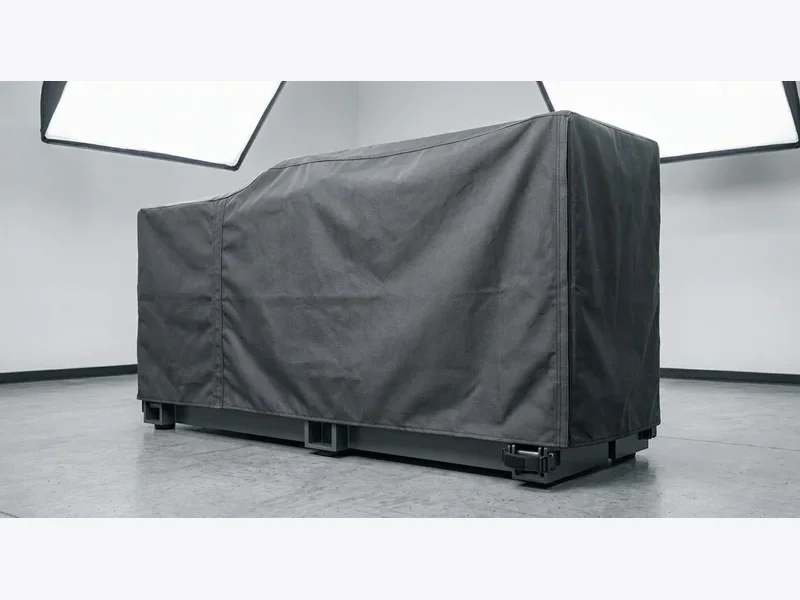
For freezer rooms where equipment cycles on and off, breathable panels or adjustable vents release trapped moisture. For steady outdoor winter storage, a fully sealed cover with heat-sealed seams keeps snowmelt and rain out.
Cover Selection by Cold Scenario
Different cold environments place different demands on a cover. Use this comparison as a starting point for your specification:
| Scenario | Typical Conditions | Recommended Material | Temperature Rating | Key Specifications |
|---|---|---|---|---|
| Cold storage compressor and condenser units | Indoor freezer rooms, high humidity, frost, frequent temperature cycling | Cold-crack-rated PVC or vinyl, 0.5 mm | -30°F or lower | Heat-sealed seams, fitted shape, adjustable vents, quick-release straps for maintenance access |
| Outdoor winter-stored construction and heavy equipment | Outdoor, wind, snow load, ice, winter sun, extreme cold snaps | Heavy-duty PVC-coated fabric, 0.6 to 0.7 mm, or TPU | -40°F | Wind-rated fasteners and straps, reinforced corners, fully waterproof, UV-stabilized for the summer months |
| Cold-chain and refrigerated transport equipment | Loading docks, vibration, frequent handling and refitting, moderate cold | TPU or coated oxford, lighter weight | -20°F | Abrasion-resistant base and edges, secure tie-downs, easy fold and store, replaceable straps |
| Frozen food processing lines during shutdown | Freezer rooms, washdown cycles, hygiene requirements, near-constant humidity | Food-grade coated fabric or PVC | -30°F | Food-safe materials with no shedding, easy wipe-down surfaces, smooth seams that resist bacterial buildup |
Application Scenarios in Practice
Cold storage compressor and condenser units. These units sit inside freezer rooms, where humidity condenses and freezes on the housing and electrical connections. A fitted cover with adjustable vents protects the unit while allowing the trapped moisture to escape when the room temperature swings. Because maintenance crews need regular access, quick-release fasteners matter as much as the material.
Outdoor winter-stored construction and heavy equipment. Excavators, generators, and compactors parked through the winter take the worst combination of conditions: extreme cold, wind, snow, and ice. The cover must be rated for your coldest recorded temperature, secured against wind with straps and reinforced anchor points, and fully waterproof. Oversizing is a common mistake; a loose cover flaps and abrades, so specify a made-to-measure fit. For more on what wears a cover out in tough conditions, see our durability guide.
Cold-chain and refrigerated transport equipment. Transport units face vibration and constant handling rather than extreme cold. A lighter, more flexible material such as TPU handles the frequent removal and refitting without cracking, and abrasion-resistant edges survive contact with dock equipment and loading ramps.
Frozen food processing lines during shutdown. When a line is idle, covers keep frost, dust, and cleaning chemicals off conveyor belts, motors, and control panels. Food-processing plants require materials that are safe for incidental food contact and easy to sanitize, which is a different specification than a standard industrial cover. Our food-grade application guide covers these requirements in detail.
Specs to Put on Your RFQ
A well-written specification prevents most cold-environment cover failures. Include these points when you request a quote:
- Minimum temperature range. State the coldest temperature the equipment experiences, not the average, and add a 10 to 15 degree margin. Require cold-flex or cold crack test data at your target temperature.
- Moisture strategy. Specify ventilation or full sealing depending on the scenario, and state the expected water column rating for outdoor covers.
- Seam and hardware construction. Heat-sealed seams for vapor-tightness, and low-temperature-rated zippers, buckles, straps, and thread. Every component must match the material's rating.
- Installation and access. Specify handles, strap placement, and access panels so crews can fit and remove the cover with gloved hands, and reach service points without removing the whole cover.
- Wind and fit for outdoor use. Reinforced corners, anchor points, and a made-to-measure fit that prevents flapping and chafing.
Important: A temperature rating is only as good as the testing behind it. Ask which test method was used and whether the rating covers the finished cover, including seams and hardware, rather than just the raw fabric.
Conclusion
Cold storage and below-freezing conditions are not a place for guesswork. A cover that cannot flex at your coldest temperature, cannot manage moisture, or does not fit will fail at exactly the moment your equipment is most exposed.
Start with the temperature rating, decide your moisture strategy, and put the specifications above on your RFQ. With the right material and construction, a cold-environment cover protects your equipment through years of freezer-room cycles and outdoor winters, and it pays for itself in avoided repair and downtime costs.
Not Sure Which Cold-Rated Cover You Need?
Tell us your equipment type, your coldest recorded temperature, and whether the cover will be used indoors or outdoors. We will recommend the right material and construction. Free assessment, no obligation.
Get Expert AdviceAbout the author: CustomMachineCover specializes in custom protective covers for industrial equipment, with materials selected and tested for low-temperature flexibility, moisture control, and long service life in cold environments.
Related articles:
- Cold Crack Resistance Explained: What -40°F Means
- PVC vs PU vs PE: Industrial Cover Material Guide
- Industrial Equipment Cover Durability: What Wears Covers Out
- Generator Cover Weatherproof Guide: Outdoor Protection Basics